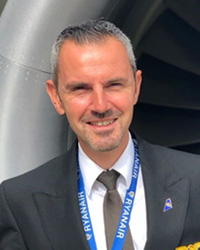
Carlos Sequeira
- Airline Pilot, Psychologist, and Human Factors Expert
- Ryanair
Carlos Sequeira, Airline Pilot and Human Factor Expert, Ryanair (Belgium and Ireland)
Carlos Sequeira is an airline pilot, and aviation Human Factors expert with nearly 30 years of operational, training, and safety experience. He currently leads Human Performance & Limitations instruction and CBTA assessment at CAE, bringing strong operational realism to training design and delivery.
Since 2020, he has supported the SESAR Deployment Manager as an Air Traffic Management subject matter expert, contributing to the implementation of datalink and other technologies within the Single European Sky. He has recently been appointed as an expert to the European Commission’s Expert Group on the Human Dimension of the Single European Sky (CEGHD), where he focuses on the human implications of automation, system integration, and organisational change.
Carlos holds an undergraduate degree in Psychology, and a Master’s in Aviation Human Factors from Coventry University, where his research examined psychological resilience in ab-initio pilots, and its relationship with stress and wellbeing. More recently, he has researched the psychology behind change management and the role of psychological resilience in building more adaptable workforces His work bridges engineering and operations by translating human performance science into practical applications for system design, certification, and training.
A regular speaker at international forums (e.g., NM User Forum 2024, ICNS24, Pilot Expo 2025, IASS 2025), Carlos advocates for human-centric approaches to automation, emphasising the importance of resilience, cognitive workload management, and maintaining meaningful human control in increasingly complex aviation systems.
Sessions
-
Human‑Machine Teaming
As AI, automation, and virtual systems transform flight decks, the relationship between pilots and machines is being redefined. We explore the evolution from traditional interfaces and autopilots to true human–machine teaming, where the pilot remains central “in the loop.” How can intelligent systems generate and communicate scenarios, assist decision-making, and how emerging technologies—such as AR-enabled displays, adaptive interfaces, and virtual copilots— can enhance pilot performance and trust. It will also look at the balance between innovation, human factors, and regulatory constraints to ensure safety and usability remain at the core of next-generation cockpit design.