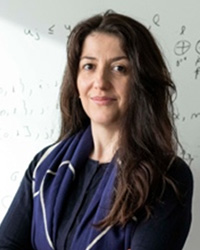
Dr Adriana Gogonel
- Product Director
- Vector, France
Former CEO and co-founder of StatInf, Adriana Gogonel has an academic background in Statistics as she completed her PhD thesis at the Paris Descartes University about Statistical post processing methods for improving medium term predictions for forecasting temperature to improve the predictions of electrical consumption in France. Among the methods that Adriana explored during her thesis are extreme value theory (EVT) and the Bayesian method. Following her PhD thesis, Adriana had a six-year post-doctoral position at Inria, Rocquencourt & Paris where she was able to apply her expertise in EVT to program execution times, which led to the writing of an academical software, EVT-Kopernic and the joint filing of two patents. Transforming the technology behind these patents into a commercial product was the reason for the creation of the company StatInf. The team of experts formed around Adriana during her six years at StatInf built a new product, RocqStat, for analysing the temporal behaviour of computer programs and estimating worst-case execution times (WCET). RocqStat was acquired in December 2025 by Vector, becoming VectorsCAST/Timing and allowing to add a timing analysis capability to VectorCAST, a product that performs code coverage and unit testing.
Sessions
-
Validation and Certification Challenges in Complex Aerospace Systems: From Mixed-Critical Architectures to Fit-to-Fly Testing
Timing - how well do you understand it?
The drive to reduce SWaP (Size, Weith and Power) through integrating mixed-critical functions on shared architectures demands rigorous testing of fault, time, and space isolation between safety-critical and non-critical partitions, including worst-case execution and interference scenarios in compliance with EASA CS-25 and ARINC 653. Concurrently, VTOL and UAV platforms require system-level validation of performance, autonomy, and safety functions within controlled sandbox environments. EUROCAE WG-112’s “fit to fly” criteria guide certification efforts, addressing airworthiness, flight dynamics and system integration, for these new aircraft types. This session explores how evolving standards and advanced testing strategies ensure robust, certifiable systems operating safely in complex aerospace environments.